
Governed Autonomy: AI that knows what not to do.
Basware’s Governed Autonomy delivers AI that operates within your controls, fully traceable and auditable.
What is Governed Autonomy?
Governed Autonomy is Basware’s operating model for AI in finance. It lets organizations expand AI authority within customer-defined controls, policies and audit trails, so autonomy, accountability and financial integrity advance together.
Governed Autonomy is AI with a point of view about what not to do.
It exists because the rules changed: AI can now run finance work end to end, but accountability for it never moved off the finance leader’s desk.
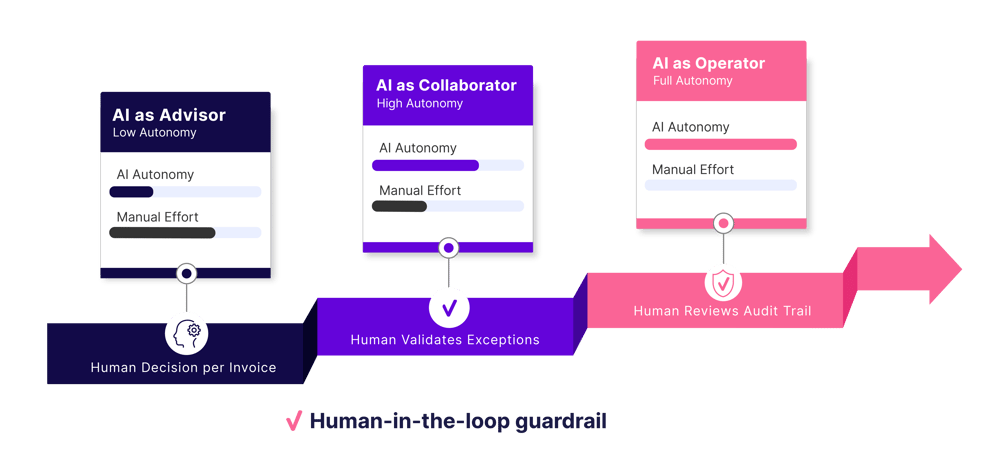
Most AI is trained only on what’s correct: the good invoices, the clean entries. Ours is trained on billions of real outcomes, including the rejects, the duplicates, the fraudulent and the miscoded. So, it knows what wrong looks like, too. Then you decide how far it acts on its own, across three stages: Adviser, Collaborator and Operator. Per process. Per risk tier. The limits stay yours.
Why transparency isn't enough
The market’s answer to AI distrust in finance has been transparency. This helps. But it’s not enough.
Transparency lets you see the decision. Governed Autonomy lets you control it.
Opacity
It acts but hides its reasoning. You cannot see why it did what it did, so the risk does not disappear. It moves to the person who signs.
Transparency
Every decision is logged, explainable and reversible. You can see what it did, but you still cannot stop it before it acts.
Governed Autonomy
It shows the reasoning, it knows what wrong looks like, and it acts only as far as you allow.
Everyone's talking about autonomy in Finance. That's the problem.
The whole market is selling finance organizations autonomy. Faster closes, touchless AP, hands off the ledger. The word has run ahead of the responsibility behind it. But existing approaches force a trade-off: highly automated finance systems create compliance and audit risk when decisions cannot be explained or traced, while tightly controlled ones give up the speed that made automation worth it.
Speed is not the goal
A CFO does not want a faster AI. They want clean books, faster, and the confidence to close. Everything else serves that.
Fast mistakes still cost
Apply AI to everything just to move quicker. And you move junk faster. That leaves you with books you cannot close and cannot trust.
Unexplained AI is a liability
Speed means nothing if you cannot defend the result. An AI you cannot question is a risk you carry personally, all the way to the audit committee.
Trust in finance is not about how fast your AI is. It is about what your AI cannot change."
Martti Nurminen, Chief Financial Officer, Basware

The control over how far the AI goes has to live with the finance leader who answers for the outcome."
Donna Wilczek, Chief Product & Technology Officer, Basware

This is real, and it's reachable
At Operator level, a finance function runs calmer than its peers. The work hasn't gone away; it has moved to where people add value: exceptions and judgment, not routing and coding.
And this isn't only for the giants. Basware runs more than 1 billion AI actions a year across 6,500+ enterprise customers, proof that autonomy and integrity scale together today. You can get here from where you are.
The Most Recognized Accounts Payable Company
"Basware has been named a Leader in the 2026 Gartner® Magic Quadrant™ for Accounts Payable Applications. Discover why we believe the future of AP goes beyond automation to Invoice Lifecycle Management powered by accountable AI, continuous compliance, and enterprise-wide control."

“Basware’s distinctive vision redefines APIA through invoice lifecycle management, unifying inbound and outbound invoicing into a single compliant zero-touch orchestration model.”

"Consider Basware if you are looking for a partner that provides a truly automated experience with deeply rooted expertise in global compliance requirements to help you scale your business."
Governed Autonomy: common questions
What is Governed Autonomy?
It's AI with a point of view about what not to do. Most AI learns only what correct looks like. Ours is different. Trained on 41 years of data across 2.5B+ invoices and $10T+ in spend, it understands both correct and incorrect outcomes at scale. That experience powers over 1B AI-driven actions annually, with you deciding how much autonomy it has.
How is it different from other finance AI?
Most vendors sell autonomy as the goal. We treat governance as the point. Every decision is logged, explainable and reversible, and you set the limits per process and per risk tier. Speed without that is just fast mistakes moving faster.
What do Adviser, Collaborator and Operator mean?
They are three stages of how far the AI acts alone. Adviser recommends and a person decides every time. Collaborator handles the routine and escalates the rest. Operator runs the process inside the limits you set, so your people focus on exceptions and judgment. You move up process by process.
Who decides how much the AI does on its own?
You do. The control over how far the AI goes stays with the finance leader who answers for the outcome, per process and per risk tier. If a vendor fixes the autonomy level for you, you have lost the governed half of Governed Autonomy.
Can I see why the AI made a decision?
Yes. Every action is logged, explainable and reversible, so an audit becomes a planning exercise rather than a reconstruction. If an AI cannot show its reasoning, you have a total lack of transparency, and that liability sits with the person who signs.
See where your finance function could run today.
Most teams are stuck choosing between speed and control. Governed Autonomy ends the trade-off. Are you ready to see where your function sits now and what moves next?